
A note that made my week
What one author wrote to his editor after months of working together

Every now and then, a piece of feedback comes through that reminds me why we do this work.
Last week, one of our authors, sent his editor a message after they’d finished editing Part 2 of his memoir. I read it three times.
Antonis is writing the story of his life. It started as one manuscript and is becoming three books. The work spans his childhood in a Cypriot village, the 1974 Turkish invasion, and his eventual exile. Much of it, he told us, is drawn from real experience. The last section of Part 2 is “99% true.”
Jane, his developmental editor, has been working with him for months. Sending edits chapter by chapter. Asking the right questions. Cutting the over-described passages. Helping him find the spine of each chapter.
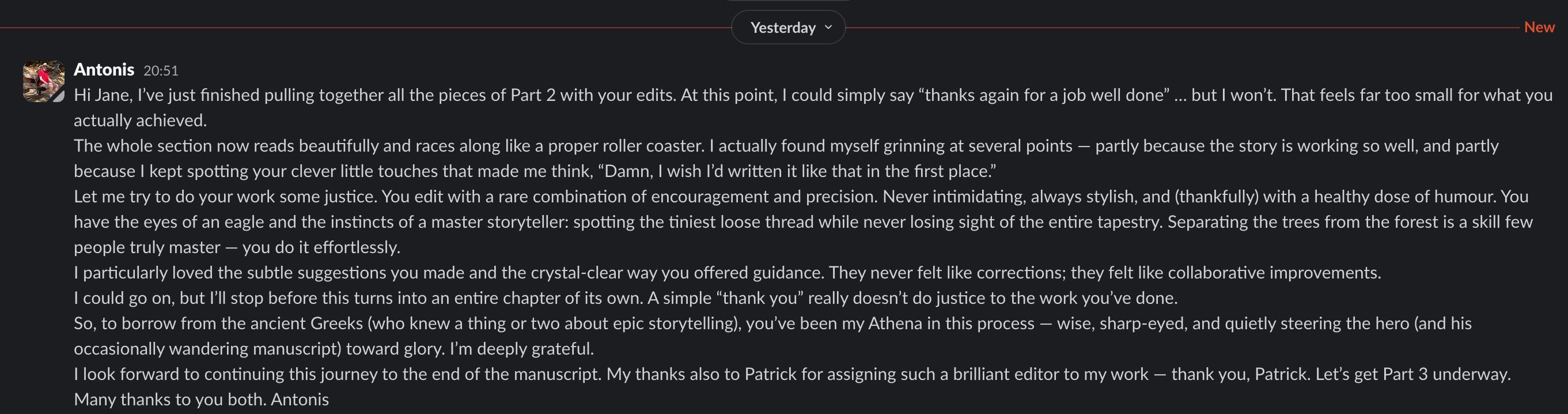
Here’s what Antonis sent her after they finished Part 2 (screenshot is below):
“You edit with a rare combination of encouragement and precision. Never intimidating, always stylish, and (thankfully) with a healthy dose of humour. You have the eyes of an eagle and the instincts of a master storyteller: spotting the tiniest loose thread while never losing sight of the entire tapestry. Separating the trees from the forest is a skill few people truly master…you do it effortlessly.
I particularly loved the subtle suggestions you made and the crystal-clear way you offered guidance. They never felt like corrections; they felt like collaborative improvements.
To borrow from the ancient Greeks (who knew a thing or two about epic storytelling), you’ve been my Athena in this process — wise, sharp-eyed, and quietly steering the hero (and his occasionally wandering manuscript) toward glory.”
This is what good developmental editing looks like from the author’s side.
Not someone correcting your work. Someone collaborating with it. Someone who can hold your entire manuscript in their head while pointing out the single sentence that isn’t pulling its weight. Someone who makes you grin at your own pages, then think “damn, I wish I’d written it that way the first time.”
Most authors never get to experience this. They write alone, edit alone, second-guess alone. They never see what their book could become with the right pair of eyes on it.
Jane is one of the editors on our team. There are others like her. If you’ve been working on a manuscript on your own for months or years, and you’re starting to wonder whether you’re too close to it to see what’s actually on the page, you probably are. That’s not a failure. It’s just what happens when you live inside a story long enough.
If that sounds like you, hit reply. We’ll take a look.
OR book a call with us here.
OR submit your manuscript and more details here.
— Patrick
PS. I have one slot open at the moment to personally work with me as your ghostwriter or dev editor (hit reply to this email to discuss)
The line that gets me — “They never felt like corrections; they felt like collaborative improvements.” That’s the whole job. An editor who corrects is doing the work of a teacher. An editor who collaborates is doing the work of a midwife: getting something out of you that was already there, that you couldn’t see because you were too close to your own labor.
I edit for a living and write a Substack on the side, and the strange thing I’ve learned is that being edited well has made me a worse client and a better writer. Worse client because I now feel the bad edits in my body. Better writer because I know what it’s supposed to feel like when someone is reading you for you, not for them.
Antonis got lucky. Most writers never find their Athena.